Foreword
In order to safeguard retail investors from risks such as price manipulation and excessive speculation, the Securities and Exchange Board of India (SEBI) has established a set of protective measures. One of these protective measures in the market is the Trade-to-Trade (T2T) segment. A T2T stock is defined as one which requires a transaction to conclude with mandatory delivery and settlement; in effect, this means intraday trading of any type is not allowed. For Indian traders using a stock or Forex platform, being aware of the T2T stock with its significantly risk adverse rules is extremely important, particularly in respect of avoiding being an unintentional trader and managing the capital risk process. This article provides a concise, detailed explanation of what T2T stocks are, how to determine if a stock is in the T2T segment and what services for stock assessment place stock in the T2T segment.
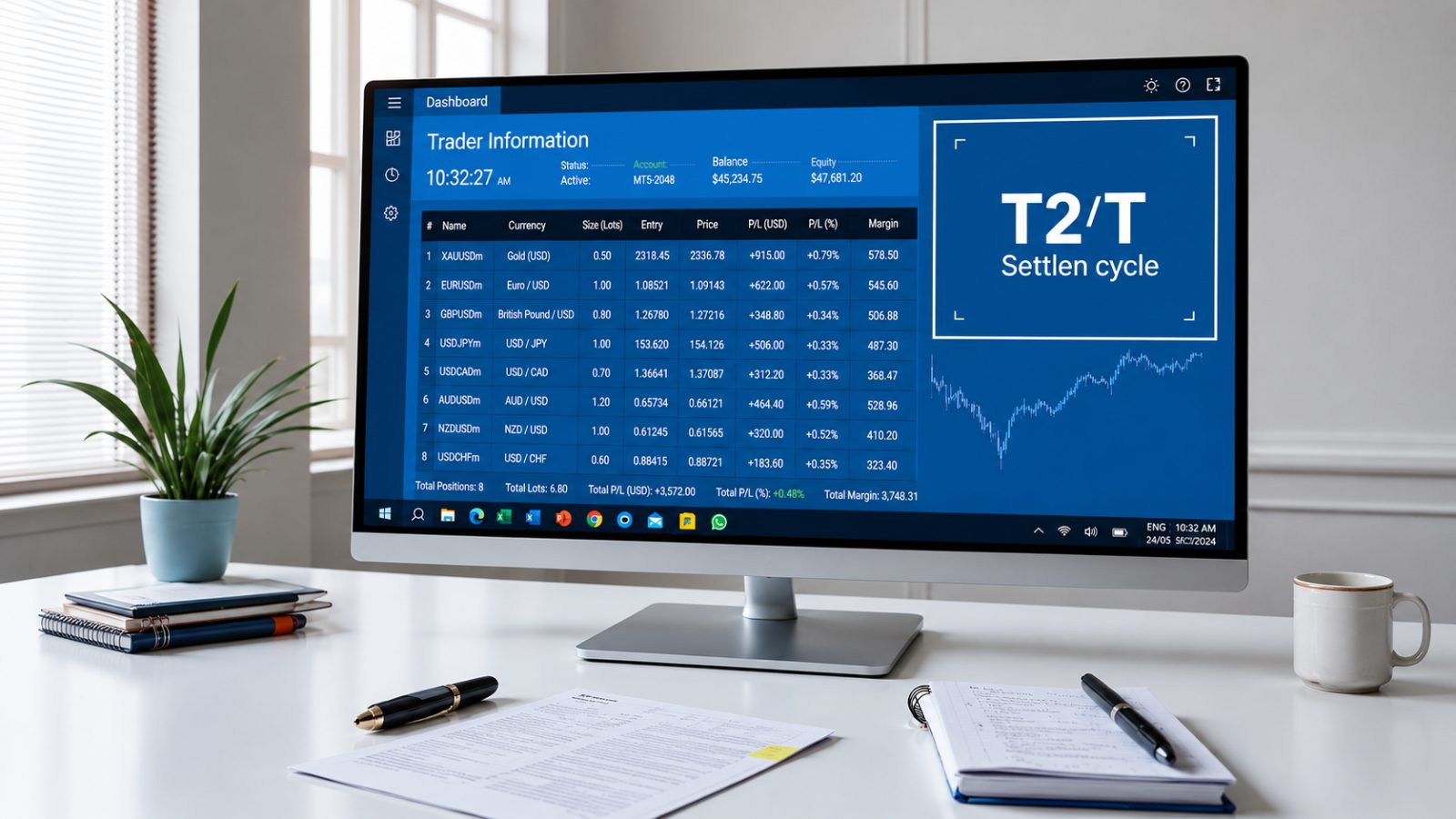
T2T shares are shares belonging to a special group according to the exchanges (like NSE and BSE) where settlements of transactions can only be done on a trade-to-trade basis. The inadvertent delivery is supposed to prevent excessive speculative transactions and to stabilize the market when trading or investing in very high volatility shares and/ or shares of smaller companies. To be clear, the primary rule that defines the T2T segment is that all trades must be settled by way of delivery. No Intraday Trading: You are not allowed to buy and sell the same T2T stock on the same trading day. This should be the first and foremost thing for you to remember. Buying: When you buy a T2T stock, you must pay the entire amount upfront while taking delivery of the shares into your Demat account (usually $T+1$ day). You are not allowed to sell the stock until the stock has been completely credited into your Demat account. Selling: When you sell a T2T stock, you must deliver the actual shares owned in your Demat account. This prevents you from short-selling and speculative naked positions. Let's say you acquire 100 shares of an NSE stock from the 'BE' series, which you pay $6.00 for per share. 1. Purchase: You pay $600.00 in cash. 2. Settlement: The 100 shares are deposited into your Demat account on T+1 (Trade date plus one working day). 3. Sale: You can sell those 100 shares only on T+2 or later, when they appear in your suppliers account. Exchanges employ a set of series codes to categorize T2T stocks, which traders should know before executing a transaction. At the NSE, stocks in the T2T segment fall under the 'BE' series (e.g., on your trading platform you would see STOCKNAME-BE). At the BSE, T2T stocks fall under Group 'T'. Sources: The best way to double check is to look at the trading segment or series on the stock exchange's website and often it may even be indicated by the trading platform as T2T. 1. Log in and search: Go to your trading platform and log in. Search for the stock you are interested in. Check if the trading series is BE or T. 2. Buy: Enter the number of shares and price. Make sure you have enough funds in your trading account to cover the entire transaction. 3. Sell: Sell once it shows in your Demat holdings. Click the 'sell' button and confirm the order. T2T stocks are categorized in this distinct group to limit excessive speculation and price manipulation. By imposing a limit on rapid intraday trading, the system incentivizes traders to consider the underlying value of the business and adopt a longer-term perspective, contributing to enhanced stability in the share market. A stock qualifies to be transferred into the T2T segment on the basis of a combination of specific criteria, typically linked to volatility risk and low liquidity. This transfer is intended to provide an element of protection from risks on theT2T stocks. The exchange mostly reviews stocks which fit into each of the criteria below: The Price-to-Earnings (P/E) Ratio: The stock's P/E is either very low or very high, meaning it is out of the ordinary, either being less than 0 (the company is not reporting earnings), or exceeding either an upper limit imposed by the Sectoral Index or Nifty P/E, which is changing based on T2T pecking order (minimum of 25 on the upper limit). Price Variation: High volatility - breaches usual price ranges, for example, if the fortnightly price variation is significantly greater than the Sectoral Index or Nifty 500 Index variation (greater than a defined percentage for example 25% with the upper threshold). In terms of market capitalisation: The exchanges focus on companies that are smaller and more at risk, evaluations focus on stocks under $6.00 crores market capitalisation. Final point Grasping the T2T segment is crucial for effective trading in the Indian stock market. T2T stocks may seem volatile and are often seen as manipulated, but all T2T means T2T, simply a regulatory measure from market regulator that aims to control trading at reasonable delivery and avoid the opportunity for intraday speculation. Remember - Always find out the stock's trading series before placing an order. When trading T2T stocks you must have 100% capital for the buy, and must hold the physical shares for the sell, thus eliminating all opportunities for intraday speculation, and tightly controlling your capital.Trade-to-Trade (T2T) Stocks: Meaning, Rules, and Risk Management
I. Understanding Compulsory Delivery
What Compulsory Delivery Means
Example of a T2T Trade
II. How to Identify and Trade T2T Stocks
Identification Codes on Exchanges
Trading T2T Stocks: The Process
Why the Separation?
III. Criteria for Shifting a Stock to the T2T Segment