Foreword
In the rapidly evolving digital landscape of today, mobile trading applications have changed how people interact with various financial markets. With mobile trading applications -sometimes called stock trading apps or investment apps - comes the ability to buy ,sell and now manage a range of financial assets - right at our fingertips. In mobile trading apps, we can monitor and manage our stocks and bonds, commodities, currencies and cryptocurrencies with an unmatched degree of ease and access. This article will provide our audience with the basic knowledge of mobile trading and everything from identifying their core functionality to the comprehensive steps for getting started specifically for our audience in India.
Mobile Trading: Simplified
In the Simplest Form The world of mobile trading applications has forever changed the landscape of personal finance and has empowered individuals to take on investment opportunities like never before. It does not matter whether you are an experienced trader or you are just starting out, familiarizing yourself with how the apps operate and how to effectively utilize their capabilities is an important step to accomplishing your goals of participating in the market.
What are Mobile Trading Apps?
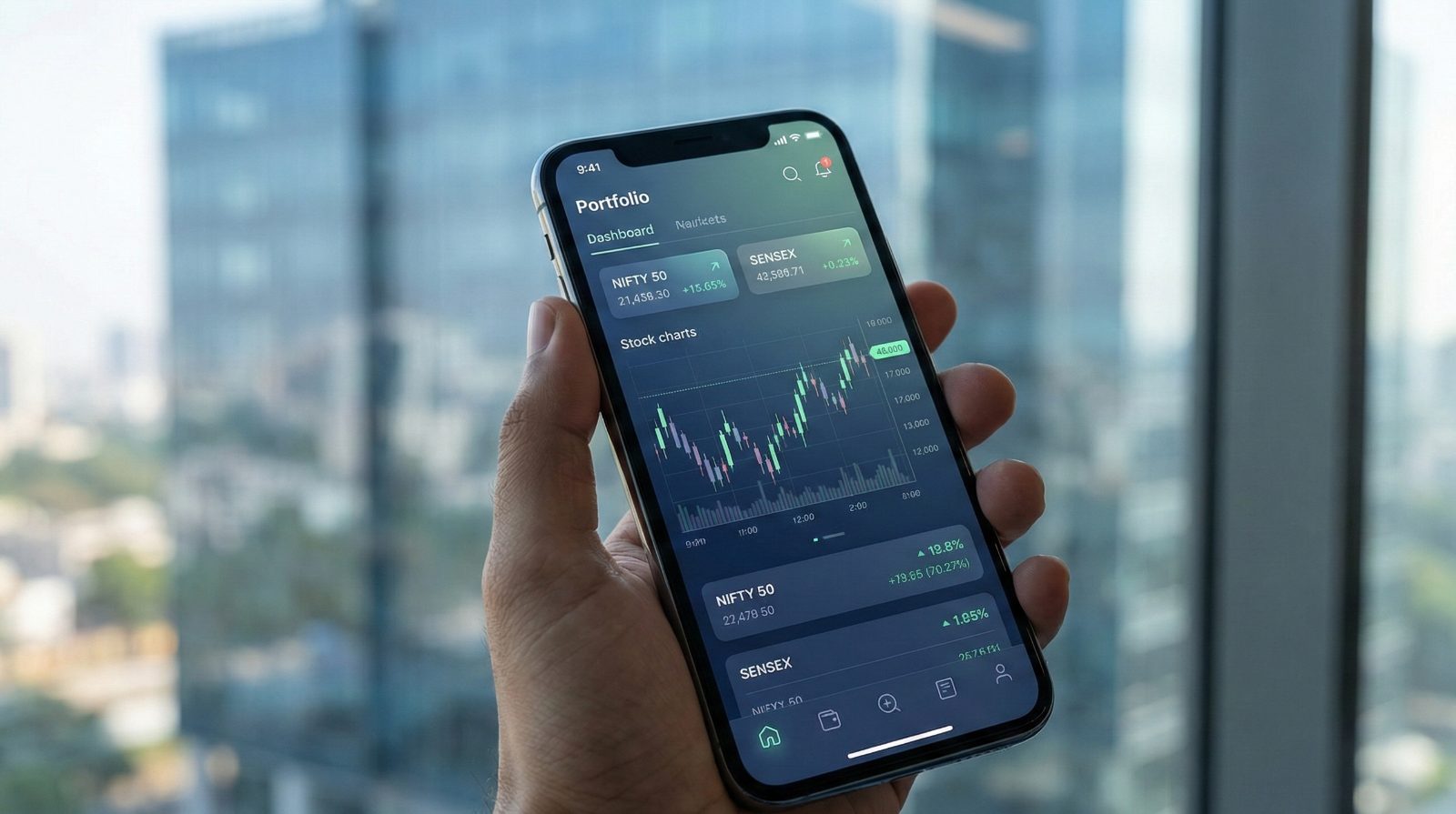
Mobile trading apps are complex software applications developed for smartphones and tablets that enable users to undertake financial transactions and asset management remotely. The latest developments in trading and investment apps, and their growing popularity, can be attributed to their ease of use, available at any time and location, and their high-level convenience as financial and investment tools.
Here is a closer look at some important factors to consider when trading using these sophisticated mobile platforms:
Fees and Commissions: Before jumping into trading on any app, it is important to understand the cost structure associated with trading. Different platforms have different fee models, which may include visible trading commissions, some price spreads (the difference between buying price and selling), and other incidental fees. Always make sure you understand what all the fees can be before trading.
Legal and Regulatory : Trading apps can be a great way to trade, but the rules for trading apps will vary and you need to have a good understanding of the regulations. Trading apps, especially in a regulated market such as India, will be subject to many strict financial regulations. For Indian users, apps that deal in Currency Derivatives and Equities must be regulated by SEBI. Any legitimate platform that you deal with will request that every user complete steps for legal identity verification via Know Your Customer (KYC)and follow the Anti-Money Laundering (AML) rules to create a safe trading environment for the user.
Market Access: These apps are the portals for your access to many financial markets. Based on your app and the broker's offering, you can access the Indian stock exchanges (NSE, BSE for equities and currency derivatives), foreign stock markets, options, futures, forex, and even cryptocurrency exchanges (if allowed).
Research and Analytical Tools: Many premium trading applications have links to sophisticated research capabilities that allow for real-time market news feeds and live data in order to make educated investment decisions. Most often you can find interactive charts, with different technical indicators, fundamental analysis reports, and breaking financial news to help track your investment thesis while moving the market.
Order Placement and Execution: From within the mobile application, you can seamlessly place orders to buy or sell financial instruments. There are different types of orders; market orders (which are executed at the market price), limit orders (which are executed either at a specified or higher price), stop orders (which are executed once a certain price ismet) and even more. Orders can be executed in real time, which allows for immediate and live interaction with the market.
Portfolio Management: An important and valuable feature of any trading app is the ability to robustly manage a portfolio. Users will frequently have the ability to view their current holdings, access to account balances, and examine their transaction history. Oftentimes there are additional features to look further into analysing the performance and tracking of your investment(s) over time and evaluating the performance of your strategies.
Online vs. Offline Trading: The Digital Edge
Mobile trading apps are making a difference in the trading experience over and beyond offline trading. Recognizing these differences also clarifies the benefits of going digital:
Intermediary Dependency: Online trading equates to your direct control of your orders - you are not totally reliant on share brokers or other intermediaries. There is total reliance on brokers in offline trading for correctly executing an order, which adds layers or steps, and often takes more time.
Order Placement Speed: The online trading app allows you to insert and then place your orders directly and immediately online - speed is critical in fast-moving markets. The offline trading process performed through your broker is manual, and does not allow for rapid order placement, but it is not even only about speed.
Proliferation of Assets: Most online trading/stock apps allow you to go from class to class(equity, currency derivatives, commodities, mutual funds (MFs),and IPOs) within the same app. Your experience with offline trading would involve broker A for MFs, broker B for equities, broker C for commodities etc., further complicating the process with many intermediaries.
Research and Advisory: Online apps make research reports, quality advice and educational content (such as blogs and study materials for novices) immediately available to everyone. In the offline model of trading, users rely on the specific advice and recommendations of their broker, potentially hampering independent research and investigation.
Real-time Data Access: Online trading provides access to live feeds and real-time market updates, allowing users to make timely and important key decisions. Offline trading usually does not provide such access to real-time data that is vital for making important decisions in trading.
Account Opening Process: Opening a trading and demat account with an online app is a completely paperless and digital task. This is time-saving and convenient. Offline trading involves long and significant paperwork for the demat account via a share broker which can be a very laborious exercise.
Transaction Speed: The entire process in online trading, from placing orders through paying money is through digital interfaces that provide very fast transaction speeds. Offline trading involves manual intervention where the speed of transactions is comparatively slower.
Target Audience: Mobile trading apps are designed with the new-age novice, as well as the tech-savvy advanced trader and investor in mind. Offline trading places you in front of the conventional and traditional trader and investor who have limited or no technological know-how beyond face-to-face and verbal interaction.
Getting Started: A Step-By-Step Guide
Batman in mobile trading is an easy process. Follow these steps to download and get the app you want to use up and running:
Step-By-Step Guide to Download and Setup a Trading App
1. Choose your broker and download the app: Start by deciding which reputable broker you want to use to reflect your trading goals, then download their trading app on your device straight from the Google Play Store (for Android) or Apple App Store (for iOS) with your Aadhaar-linked mobile number for faster downloads.
2. Sign up and prepare your documents: Next, when you open the app, sign up for the service, creating a user ID and password. You will need to have your PAN card, Aadhaar card, and account number ready for online submission, which is essential for identity identification and fund linking.
3. OTP verification: After you enter the details of your identity, you will need to enter the one-time password (OTP) that the trading app will have sent by SMS to the registered mobile number, to verify your identity and complete registration of your trading account.
4. Account Opening Fees (If Applicable): If the trading app does not offer account opening fees free of charge, the app may require you to pay account opening fees. If you are able to open an account free of charge, then continue logging in.
5. Logging In and Trading: After successful login, you can start utilizing the app's different features, make your own stock or currency pair watchlist, and start your first trades.
Key Documentation to Open a Trading Account App
It is important to prepare and submit the following documents for your account opening (Indian regulatory requirement) to ensure compliance and smooth onboarding:
Photo ID Proof
o PAN card(Compulsory)
o Voter's ID
o Passport
o Driving License
o Aadhaar card
Address Proof
o Landline bill
o Electricity bill
o Bank statement
o Ration card
o Passport
o Voter's ID
o Registered lease or sale agreement
o Driving License
Income Proof (optional, comes up at times for F&O/derivatives trading)
o Last 6 months'' bank statement
o 3 months'' salary slips
o Income Tax Return (ITR) acknowledgement
Bank Proof
o Cancelled cheque with name pre-printed
o Copy of bank passbook
o Bank statement
Additional Requirements:
o Recent passport-size photo
o Your signature on a blank piece of paper (to be used in online verification)
Our Evaluation Methodology for Top Trading Apps
When evaluating and recommending the best trading apps for the Indian financial market we have a robust methodology centered on key factors essential for a seamless and successful trading experience. There are several metrics that we will use while evaluating to determine the overall quality and suitability of each trading platform:
Speed of Execution: Speed is everything in trading, particularly in intraday or volatile trading environments. We will assess trading apps based on their reliability and execution speed, with a focus on order fulfilment speed, slippage time, and speed of trades.
Ease of Use and User Interface (UI): Any top trading app should offer a buttery smooth and intuitive user interface where users can execute even complex trades in a simple way. The level of effort needed to navigate the app and how user-friendly the app is, will be instrumental in a traders ability to implement a successful trading strategy.
Advanced Functionalities and Customization: An effective trading app ideally supports all required advanced trading features, such as advanced charting capabilities, multiple indicators and indicators types, etc. In addition, it should allow for an extensive level of customization, such that users can modify various aspects of the trading app based on their needs.
Availability of Real-Time and Live Market Feeds: This can have a major impact on the success of a trader. Real-time feeds and live market updates are absolutely essential to the success of a trading app, in that it enables the trader to react quickly to market changes.
Products Available: We assess the breadth of financial products available on the app, including multiple types of stocks, equities, mutual funds, insurance products, IPOs, etc. It is clear that a wider range of products allows for greater investment flexibility.
Clarity of Fees: We scrutinized the trading app's fee structure, including information on various charges (account opening charges, account maintenance and demat charges, etc). A trading app should be clear and transparent about all fees, so traders can manage their costs better.
Final point
Mobile trading apps can be overwhelming when first experiencing themselves, but when armed with the knowledge you need, you will feel empowered. We've covered the general capabilities of these apps and discussed the differences between online and offline trading mechanisms while providing you with a straightforward plan for setting up your trading account. Remember, we live in a digital world that has made financial markets significantly more accessible than in previous decades. You can quickly execute trades efficiently; you have an abundance of information at your fingertips; it is quick and easy! However, you must remember, you are responsible for ensuring compliance with regulations and knowing your fee structures. Use educational and demo accounts as your tool belt. Your success does not solely depend on whether the app has all the functions you want; it also relies on how prepared and informed you are when it comes to decision-making. By following the guidelines in this article, you should have for the most part made it through the decision-making process as to what app or platform you want to use and become an informed creator of your safety and security along your at-home trading journey! What part of mobile trading are you excited now to delve into?